The Soul Fleet Rolls Through Stone and Sky
%2520(1).png&w=3840&q=90)
I. The Arrival
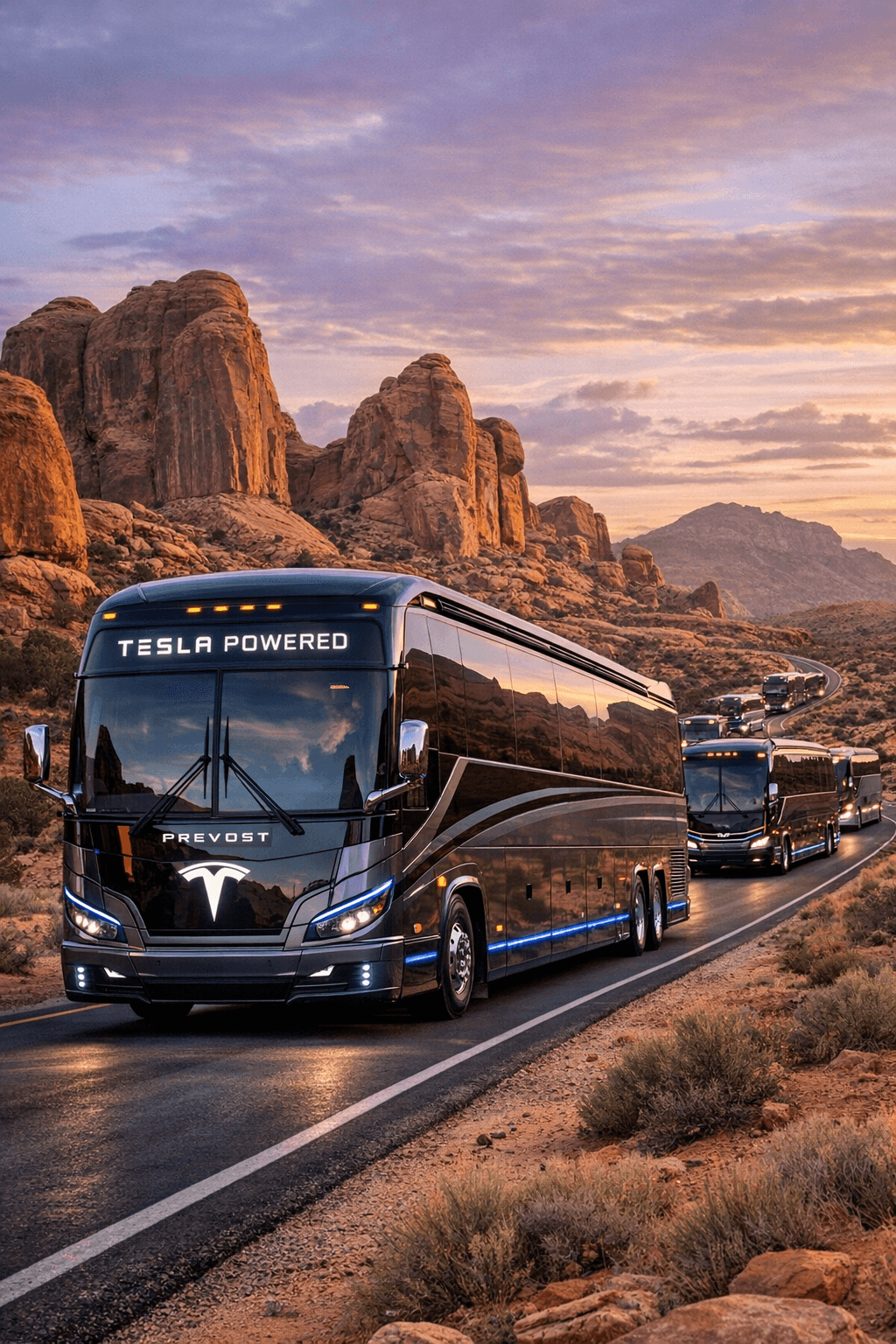
You hear it before you understand it — or rather, you don't hear it, and that's what stops you. You're standing on the shoulder of the scenic drive just north of the Courthouse Towers, red dust on your boots, the late-afternoon sun laying copper across every surface it can reach, and something is coming around the bend. Something enormous. A forty-five-foot Prevost H3-45, brushed in titanium-silver, its roofline carrying a constellation of solar panels that catch the light like fish scales. It is silent. No diesel clatter. No Jake brake howling off the canyon walls. Just the low, tidal hum of electric motors and the faint crunch of Continental rubber on pavement. Behind it, another. Then another. Five coaches, moving in formation through a corridor of Entrada sandstone that rises two hundred feet on either side, each tower and fin stained in bands of rust, ochre, and dried-blood red. The fleet passes beneath the Courthouse Towers the way tall ships once passed through harbor gates — with weight, with intention, with the quiet authority of vessels that know where they are going.
The contrast is almost too much for a single frame. These stone formations are 300 million years in the making — Permian-age sediment compressed, uplifted, fractured, and sculpted by water that has mostly left this country behind. And here, gliding through their shadows, is the bleeding edge of what human engineering can do in the twenty-first century: battery-electric powertrains delivering instant torque to axles that don't burn a single molecule of fossil carbon. The ancient and the arriving, sharing the same road. The stone doesn't care. It was here before the internal combustion engine, and it will be here long after the last one is scrapped. But the fleet — the fleet cares. The fleet chose this place on purpose.
If you were standing there, you'd feel it in your sternum: that particular silence that happens when something very large moves very quietly. It's the silence of held breath. Of threshold. Of a world tilting, just slightly, toward something it hasn't been before.

II. What Is the Soul Fleet
The Soul Fleet is not a product. It is not a brand. It is not a startup pitch wrapped in renderings and a waitlist. It is a philosophy of movement — and it starts with a refusal. A refusal to choose between luxury and freedom. Between rootedness and range. Between building a home and leaving one. The Soul Fleet says: the vehicle is the home, the road is the neighborhood, and the horizon is the property line. These are not RVs. Call them landships. Self-contained, autonomous-capable vessels designed for people who have decided that staying in one place is not the only way to stay grounded.
Picture a flotilla of electric Prevost conversions — each one a rolling sanctuary of hardwood, stone countertops, and climate-controlled silence — moving together across the American landscape. Not in a convoy. In formation. The distinction matters. A convoy is logistics. Formation is choreography. Formation is a pod of whales crossing open ocean, each body sovereign, each trajectory chosen, the collective shape emerging from shared instinct rather than command. The Soul Fleet is a caravan of the future assembled from the oldest human technology there is: the decision to travel together.
The people inside these coaches are not a demographic. They are a cross-section filed under one common heading: they are done waiting. Engineers who spent twenty years in cubicles and now want to build things with their hands while parked above a river gorge in New Mexico. Artists who need the light to change every week. Veterans who found that the only thing that quiets the noise is distance, covered at their own speed. Families who pulled their kids out of school — not out of fear, but out of faith that the world itself is curriculum enough. Each coach is sovereign. No corporate hierarchy, no membership dues, no bylaws. The fleet is chosen family in motion. You join by showing up. You stay by being someone worth traveling beside.
The Soul Fleet says: the vehicle is the home, the road is the neighborhood, and the horizon is the property line.
This reimagines what a "fleet" even means. Strip away the commercial connotation — the delivery trucks, the rental car lots, the municipal bus depots. Replace it with something older and stranger: the wagon train, the merchant caravan, the fishing fleet that leaves port together because the sea is easier to survive in company. The Soul Fleet is communal pilgrimage dressed in carbon fiber and lithium iron phosphate. It is the American road trip freed from its extractive legacy and rebuilt as something that gives back more than it takes.

III. Tesla Meets Prevost — The Engineering Case
Let's get under the hood — or rather, under the floor, because that's where the future lives. Prevost has been building the strongest, safest motorcoach platform in North America for over a century. Their H3-45 is not a body-on-frame vehicle like the recreational conversions you see sagging in RV parks. It is a fully integrated stainless steel monocoque — a unibody shell where the structure is the skin and the skin is the structure, engineered to carry load and absorb impact simultaneously. It is, without exaggeration, the finest canvas in the motorcoach world. The current powertrain is a Volvo D13 diesel mated to an Allison automatic transmission: proven, reliable, and burning roughly one mile per gallon of diesel fuel. The Soul Fleet vision removes that diesel heart and replaces it with Tesla's electric powertrain architecture.
Here is why this is not fantasy. The Tesla Semi, which entered limited production in 2022 and has expanded since, uses approximately 1,000 kWh of battery capacity spread across a tri-motor drivetrain to deliver 500 miles of range at a gross vehicle weight of 82,000 pounds. A fully loaded Prevost H3-45 conversion tips the scales at roughly 54,000 pounds — almost 30,000 pounds lighter than a loaded Semi. The math is favorable. With comparable battery pack capacity integrated into the underbody — replacing the diesel engine, transmission tunnel, fuel tanks, and DEF system that currently occupy that space — a Tesla-powered Prevost could achieve 500 miles or more per charge. The weight savings of the coach versus the Semi are partially offset by the higher aerodynamic drag of a flat-fronted bus, but the net equation still lands in territory that is not just viable but compelling.
Consider the secondary advantages. Floor-mounted battery packs drop the center of gravity significantly below where a diesel engine and transmission sit, improving cornering stability and reducing rollover risk — a genuine safety gain for a vehicle this tall. Regenerative braking on long descents transforms kinetic energy back into stored charge; imagine the energy recapture rolling down from the Colorado Plateau into Moab, a 2,000-foot elevation loss over twenty miles of switchbacks that currently turns to heat in brake drums. In an electric Prevost, that descent is a deposit, not a withdrawal. Thermal management systems — liquid-cooled battery conditioning of the kind Tesla has refined across millions of vehicles — handle the desert heat that would punish lesser packs. And the roofline, that vast flat expanse of real estate, becomes a solar array. Companies like LOKI Coach in Québec City are already building Prevost conversions with 96 kWh onboard lithium battery banks and rooftop solar sufficient for 36 hours of off-grid autonomy. Scale that solar capacity across a Tesla-architected energy system and you have a coach that charges itself while parked, that tops off while you sleep under stars in a BLM dispersed camping area, that treats the sun as fuel.
Then there is the experience. No vibration. No exhaust. No hundred-decibel diesel roar at highway speed. A Tesla-powered Prevost would be the quietest luxury vehicle on the road — a rolling meditation chamber that delivers instant torque for mountain grades, that passes through national parks without leaving a chemical signature in the air, that lets you hear the canyon wren through an open window at sixty miles per hour. This is not just zero-emission. This is zero-intrusion.
IV. Arches as Threshold
There are over 2,000 natural stone arches cataloged in this park, and every single one of them is a door. That is not poetry. That is structural fact. An arch, in architecture, is the oldest solution to the problem of spanning open space while bearing weight — the Romans knew it, the Nabataeans knew it, and the Entrada sandstone figured it out without any engineering input at all. Each arch is a threshold: a frame through which you see what's on the other side, a passage that implies you could walk through and arrive somewhere different. The Soul Fleet passing through Arches National Park is not scenery. It is visual metaphor made literal. These vehicles — these silent, electric, self-sustaining vessels — are crossing from what was into what's next. From fossil fuel dependence to electric sovereignty. From isolation to intentional community. From the old American road trip, with its trail of carbon and noise, to something that moves through the landscape the way light does: without residue.
The American road trip has always been a spiritual practice disguised as recreation. From the Oregon Trail to Route 66 to Kerouac's restless, benzedrine-fueled dashes across the continent, the act of leaving home to find yourself is embedded in the national DNA like rebar in concrete. But that tradition has carried a cost — extraction, emission, the slow poisoning of the very landscapes that were supposed to heal us. The Soul Fleet inherits the mythos but strips away the tax. No carbon trail. No noise pollution. No taking from the land you are crossing. This is pilgrimage that gives back. The desert asks nothing of you except attention, and these coaches are quiet enough to pay it.
Each arch is a threshold — a frame through which you see what's on the other side. The Soul Fleet passing through Arches is visual metaphor made literal.
There is something almost sacramental about the geometry of it. A forty-five-foot coach passing beneath a sixty-five-foot natural arch, both of them engineered — one by human hands, one by erosion — to carry enormous weight while creating space beneath. Both of them temporary, on a long enough timeline. The stone arches are falling. Landscape Arch, the longest in the park at 306 feet, lost a slab the size of a school bus in 1991. Wall Arch collapsed entirely in 2008. The park is a museum of impermanence. And the fleet, too, is passing through. But both — the stone and the steel — stand long enough to mean something. Long enough to be beautiful. Long enough to be doors.
V. The Dream Made Practical
Let's be clear about where the horizon line sits. Tesla has not announced an RV or motorcoach platform, and Prevost has not publicly discussed an electric variant of the H3-45. But the component technologies are no longer theoretical. The Tesla Semi proved that a megawatt-class battery electric powertrain can move heavy vehicles at highway speed over meaningful distances. The Megacharger network, designed to add 400 miles of range in 30 minutes at up to 1.5 MW, is expanding across freight corridors that overlap heavily with the interstate routes a touring motorcoach would travel. The NACS charging standard — Tesla's connector, now adopted by every major automaker — is becoming the universal socket. A cross-country electric coach journey is not yet routine, but it is approaching feasibility with the speed of a technology curve that has consistently outrun its skeptics.
Meanwhile, the conversion industry is not standing still. LOKI Coach has demonstrated that a Prevost shell can be fitted with comprehensive onboard energy systems — lithium battery banks, rooftop solar, inverter arrays — sufficient to run climate control, induction cooktops, and full residential electrical loads for a day and a half without plugging in. The gap between "off-grid capable luxury coach" and "fully electric luxury coach" is narrowing from both sides: battery energy density climbing, charging infrastructure spreading, solar efficiency improving, and the cost per kilowatt-hour of lithium iron phosphate cells dropping year over year. The Soul Fleet vision sits at the convergence point of technologies that already exist independently. It is not science fiction. It is integration waiting to happen.
This is where SpacesAngels.com enters the frame — not as a company, but as a commons. A gathering point for the people who look at a Prevost coach and a Tesla powertrain and a desert highway and see not three separate things but one inevitable combination. Engineers who want to solve the thermal management problem. Designers who want to rethink what interior space means when the drivetrain no longer dictates the floor plan. Investors who understand that the luxury travel market is migrating toward experiences that don't require apology. Travelers who are already living on the road and want to do it cleaner, quieter, further. The Soul Fleet is an invitation. It is a campfire around which a community is forming — not to sell something, but to build something. If you can see it, you're already part of it.
The La Sal Mountains at sunset — the road ahead, lit from behind.
VI. The Road Ahead
The sun drops behind the La Sal Mountains and the desert does what it does every evening: it forgives the heat. The air cools ten degrees in fifteen minutes. The sandstone, which spent all day radiating, begins to hold its warmth like a body under blankets. The fleet rolls out of Arches on the southern road, five silver coaches in loose formation, their battery gauges reading higher than when they entered — the long regenerative descent from the park's high country putting charge back into packs that were already near full. Headlights come on in sequence, LED arrays throwing clean white light down an empty two-lane. Above, the stars are arriving in their own formation, the Milky Way assembling itself across a sky that has never known light pollution and, if the Soul Fleet has anything to say about it, never will.
The road ahead is dark and open. The road ahead has always been there — beneath the wagon ruts, beneath the asphalt, beneath the diesel soot — waiting for someone to travel it without leaving a mark. The Soul Fleet doesn't need headlights to know where it's going. But it has them. And they are pointed forward. If you can feel the pull of that road from wherever you're sitting right now — if the silence between these words sounds like electric motors and desert wind — then the fleet has a space for you. The arch is open. Walk through.