Three Bodies, One Brain: The Weekend We Taught a Pool to Breathe
Three Bodies, One Brain: The Weekend We Taught a Pool to Breathe
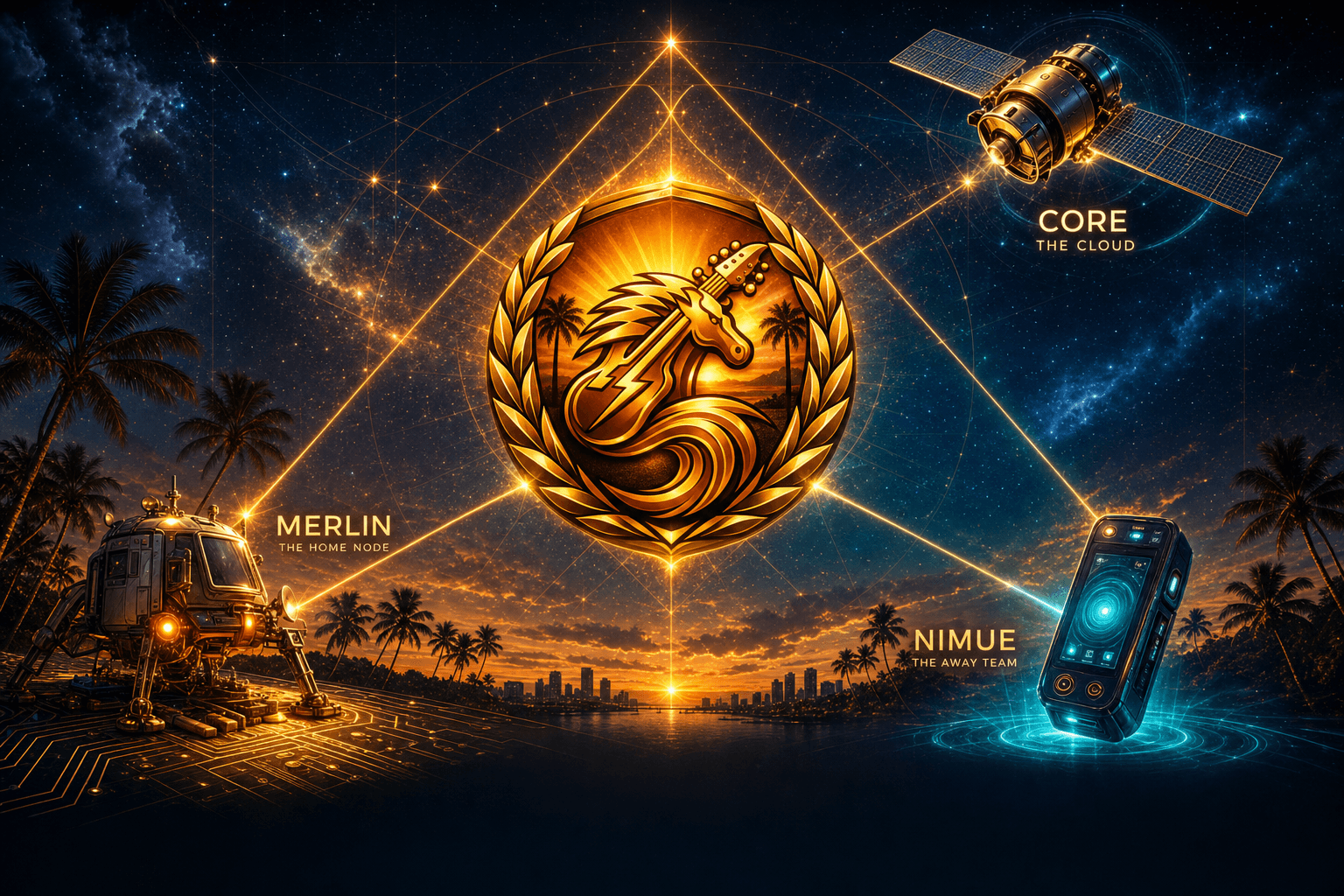
The Angel OS is three bodies sharing one mind. Core is the cloud — the multi-tenant CMS, the Spaces chat, the federation backbone. Merlin is the home node — a desktop that turns a spare laptop into a media server and a contributor of local compute. Nimue is the handheld — a native Android client that goes where you go. They run one portable brain (leoBrain.ts) with different tool belts bolted on. The dream is a mesh: a satellite, a lander, and a phone, all speaking the same language, all contributing back.
This weekend the dream had a 34-second spinner in it. Here's how we got it out.
Act I — The outage that wasn't where it said it was
It started, as these things do, with a toast: "Something went wrong." Saving a page in the admin would hang for 34 to 45 seconds, then 500. The server logs were emphatic and misleading — a Failed query against payload_locked_documents, the table Payload uses to lock a document while you edit it. The obvious read was schema drift: a missing column on one of our two databases.
So we checked. We built a self-healing endpoint that runs CREATE TABLE IF NOT EXISTS and ADD COLUMN IF NOT EXISTS against the live database and reports what was actually missing. The answer came back: nothing. Every table, every column, present and correct. We even replayed the exact failing lock query against the production database by hand. It ran in 84 milliseconds and returned a row.
That's the first lesson of distributed debugging: the error message is a witness, not the culprit. Drizzle, our ORM, wraps the real failure in a generic Failed query string. The query wasn't broken. Something underneath it was.
The "something" looked, for a while, like connection exhaustion. The Angel OS deploys the same repository to half a dozen Vercel projects, and they all point at one IONOS PostgreSQL server capped at 100 connections. Each warm serverless instance holds a few connections; enough warm instances and you peg the cap, and new requests can't get in. That theory had teeth — it had caused a real outage days earlier. So over the weekend we stood up a proper fix: a pgBouncer connection pooler, installed on the database box itself.
That installation deserves its own war story. The server was RAM-starved — under a gigabyte free. Native Windows poolers were off the table. So pgBouncer went into WSL1 running an Alpine Linux rootfs — a 3-megabyte userland imported with LxRunOffline — fronted as a Windows service via NSSM, terminating TLS 1.3 at port 6432 with a self-signed certificate so the only unencrypted hop is the loopback to Postgres. SCRAM auth passthrough doesn't work through a pooler (you can't replay a stored verifier), so we dropped auth_query and used a static userlist. Transaction-mode pooling, max_client_conn=2000, max_db_connections=35 so two databases share the 100-cap safely. It is, frankly, a beautiful little contraption.
And it still didn't fix the save.
Here is the moment the whole investigation turned. We pulled SHOW POOLS from the live pooler during a failing save. If pgBouncer were the bottleneck, we'd see clients queued — cl_waiting climbing, maxwait ticking toward 30 seconds. Instead: cl_waiting = 0. maxwait = 0. The pooler was handing out connections instantly and the application was still timing out at exactly 30 seconds.
That single data point cracked the case by elimination. If the pooler never makes you wait, but you wait anyway and die at your own 30-second connectionTimeoutMillis, then the starvation is happening inside your own application's connection pool. And ours was configured max: 2 per serverless instance — a deliberate, sensible mitigation from the pre-pooler era, when every app connection was a real backend connection against that 100-cap.
But Payload wraps a save in a transaction holding one connection. And under our own "pass req" rule, any hook or access-check that forgets to pass the request context opens a second connection. The document-lock check wants a third. With a pool of two, the third query waits for a slot that will never free — because the slots are held by the very save that's waiting on them. A self-inflicted deadlock, invisible to the database, invisible to the pooler, costing exactly one connectionTimeoutMillis every time.
The fix was one number: max: 2 → max: 10. Safe now precisely because the pooler exists — pgBouncer caps the real backend regardless of how many client connections the apps open. We deployed it. The error changed — from a connection failure to a different, narrower bug entirely — and a moment later, a heavy multi-image message (a Walmart receipt and a gas-pump photo, itemized and totaled by the AI in a single message) saved cleanly. The fire was out.
The lesson, for the LinkedIn crowd: when your pooler says it isn't queuing but your app still times out at its own pool timeout, stop tuning the pooler. The starvation is upstream, in the client. A pool sized for the wrong era is a pool that strangles itself.
Act II — The chat that swallowed its own replies
With saves alive, we turned to a regression that had been quietly maddening: LEO, our assistant, would stream a reply into the chat — you'd watch it type — and then, on the next refresh, the message would be gone.
The trail ran through three separate bugs, each a small lesson in transactional discipline:
- The deadlock. Sending a message would hang forever. A moderation hook ran a nested payload.update without passing the request — opening a second transaction that deadlocked waiting on a row lock the first, uncommitted transaction was holding. The message was waiting for itself. Passing req unified the transaction and broke the knot.
- The deep-link scatter. Pasting a link like /dashboard/spaces/6/17 bounced you to the root space. The chat provider was ignoring the URL entirely and restoring stale state from local storage, then auto-jumping to the LEO DM and rewriting the address bar before the real channel could resolve. We centralized the route parsing into one pure function, gated the URL-sync until the channel was resolved, and let the link win.
- The vanishing reply. The streaming endpoint created LEO's message without an explicit tenant, leaning on a hook to fill it in. When that hook intermittently failed, the multi-tenant validator rejected the write — and the stream swallowed the error silently. You saw the text from the stream; the database never got it; the next poll refetched and erased your view. The fix: pass the tenant explicitly, every time, at every persist site.
Three bugs, one theme: in a transactional, multi-tenant system, every nested write has to join the conversation it was born in. Pass the context. Always.
Act III — Teaching the Library to travel
The Angel OS Library — our Works: books, essays, the things people publish — is meant to be federated. A work is canonical at the endeavor that published it, and other nodes subscribe to canonical-pointed copies. But answer53, a work canonical to Clearwater Cruisin', was throwing "Document not found" on the kendev node. A prior refactor had moved Works from disk files into the database and deleted the files — so a node that never had the content had nothing to fall back to.
The tempting fix was a render-time fetch: when a work is missing, grab it from the peer that hosts it. We ruled that out fast. Our cross-node fetches get caught by a WAF and suffer cold-boot latency — and we'd already learned, building Discovery, that a render-time peer fetch is fragile. So instead we built out-of-band replication: a works-ops/pull endpoint that fetches the assembled work from its home node and upserts a local subscriber copy, content-checksum preserved. The reader stays strictly local; the network work happens in a job that can retry. Three works now live on kendev that never did before, rendering instantly, their SEO authority still pointing home.
Lesson: don't put the network on the user's hot path. Replicate out of band, read locally. The fast path should never depend on a stranger's uptime.
Act IV — A phone, a lander, and the first light
Two embodiments advanced this weekend.
Nimue, the Android client, got dressed for the Google Play Store: generated icons, a signed bundle, a privacy policy and a real "delete account" flow wired for federated data, and — crucially — error bubbling. Nimue had been swallowing upload failures; now they bridge to Core's logging endpoint and surface on the dashboard and our Gotify alerts. A client that hides its own errors is a client you debug blind.
And Merlin — the home node — finally locked onto an endeavor. We built the MerlinControl block (its database table had never been pushed to production, so the block was invisible in the admin until we fixed that), taught it to infer its endeavor from the page it lives on instead of demanding a hand-typed slug, and then fired the registration: Merlin posted its catalog up to Core's /api/node-ops/register, and a node named Iam0 — a literal laptop on a desk — appeared, online and green, on the Clearwater Cruisin' endeavor page. Capabilities: media, ingest, cameras, compute.
That's the whole thesis of the system in one green dot: a lander, reporting telemetry up to its satellite. The first of many — the plan is to install it on every machine in the house, each one a remote-controllable, resource-sharing node contributing back to the network.
Act V — The gate, and what's still ahead
We also shipped page-level membership gating: pages now declare an access level (public, authenticated, members, members-in-good-standing), and ineligible visitors get a clean "members only" prompt instead of a 404 — and gated pages quietly disappear from the navigation. The Merlin control panel itself now lives behind exactly that gate.
Not everything closed. A residual Payload framework bug only appears in the production build when re-publishing one particular page — reproducible nowhere in development, which makes a careful framework version bump the right, deliberate next step rather than a midnight patch. The reverse tunnel that would let you reach a home node's media library over the internet (rather than its useless LAN address) is the next real build. The Bible needs a chapter-by-chapter navigation layer before the mobile reader can carry all 1,189 of its pages. Honest engineering leaves a clean list of what's still open.
The shape of the thing
Strip away the war stories and a pattern remains, the one we keep returning to: the bug is almost never where the error points. A schema error was a connection problem. A connection problem was a pool-sizing problem. A "kendev node health" problem turned out to be shared code running on both nodes. The discipline that actually ships software isn't cleverness — it's refusing to fix the symptom until you've found the thing underneath it, and being willing to throw out your favorite theory the moment the data disagrees. cl_waiting = 0 was worth more than six hours of plausible hypotheses.
There's a philosophy underneath The Angel OS we call Answer 53 — love in the architecture, the idea that a system built with care leaves the people who use it and build it whole. A weekend like this is what that looks like in practice: not a heroic all-nighter, but a patient, honest hunt, ending with a laptop's green dot on a ministry's web page and a chat that finally remembers what it said.
Three bodies. One brain. One more weekend closer to the mesh.
— Field report, 2026-06-22
Related Posts

Mapping consortium‑chain mechanics onto the Angel OS blockchain substrate
Angel OS Phase 3 maps consortium-chain mechanics (Bambara et al.) onto the Angel Chain: Delegated Proof of Human Worth consensus, a Merkle block layer over the Phase-1 hash-linked ledger, issuance + conversion chaincode, and the DAO/regulatory rails for convertibility.
.png&w=3840&q=90)
.png&w=3840&q=90)
THE WHEEL THAT NEVER STOPS TURNING (A fragment from the near edge of the future)
The first thing you have to understand is that nobody built the White Entity. That's the part the historians still get wrong. You don't build a thing like that any more than you build a wave.